For Malyia McNaughton, founder and designer of Made by Malyia, jewelry is movement, memory, and meaning cast in gold. Her pieces balance strength and sensuality, structure and story. “Jewellery started as my refuge,” she says. “It became a way to express what I couldn’t always say out loud.” McNaughton came to jewellery through self-expression rather than inheritance. After several years as a fashion buyer, and with a background in fashion merchandising and product development, she began creating jewelry as a hobby, and her approach evolved through travel and study. Encounters with artisans and materials across Botswana, South Africa, India, France and the UK deepened her appreciation for how culture, craftsmanship and nature intertwine. Here’s more from our interview with her…
Can you share your journey into jewelry, and what first inspired you to become a jeweler or designer?
I came to jewelry through self-expression. After several years as a fashion buyer, and with a background in fashion merchandising and product development, I started making pieces as a hobby because I wanted jewelry that spoke differently. The first necklace I finished turned into quiet requests from friends, then clients. Only later did I realize the true spark began at five, when my mother gave me my first gold bangle. Its weight, curve, and simplicity still guide my proportions today.
Travel deepened the pull. Seeing design and craft across Botswana, South Africa, India, Paris, and London showed me how the intersection of art and nature lives in metal and stone. I formalized my training at GIA so I could honor the materials and equip my clients with accurate information. Today I design the way I dress and move through cities: clean lines, sculptural forms, and pieces that feel personal, versatile, and meant to be lived in.
How does your generation’s perspective (Gen Z/Millennial) reflected in the way you design or run your business?
I design for a generation that values transparency, flexibility, and community. I build with modularity and multiple wear options, I share processes openly, and I run the business with digital tools, and direct conversations with my audience. I believe Gen Z and Millennials want the same things from jewelry in a lot of ways. Gen Z wants more access to the process, inspiration and community, which is reflected in a lot of the ways that I run the business and informs my designs.
Who or what are some of your biggest creative influences?
New York trained my eye. I’m that person who stares up at bridges and notices the quiet hardware that holds the city together. Bolts, rivets, fire escapes, the rhythm of subway grates. Those lines show up in my work as clean geometry, engineered joints, and negative space that lets light breathe.
My Caribbean heritage keeps me grounded in warmth, movement, and storytelling. I think about the curve of a bangle my mother gave me, the glow of skin against gold, and the way celebration lives in small, intentional details. The ocean is a constant reference. Shell spirals, wave edges, and constellations guide the proportions I choose and how stones are set.
From learning how diamonds move through Botswana and South Africa to visiting cutting rooms in India to studying design sensibilities in Paris and London, I collect textures, colours, and forms. Museums and street art are right next to architecture in my sketchbook. I am as inspired by a Richard Serra curve as I am by a wrought-iron gate or a hand-painted sign in a market. Because I came to jewelry through fashion, I design with the body and wardrobe in mind. I love pieces that shift with you. A pendant that clips into a choker, an ear cuff that stacks with studs, a ring that can be worn two ways. I look to design houses that balance bold shape with proportion, then translate that into mechanisms and silhouettes that are modern, personal and easy to live in. Nature, architecture, art and travel are not separate lanes for me. They are one conversation about structure and emotion. My job is to distill all of that into gold and stone so that the piece feels like a story you can wear.
What is a jewel that you designed that has a particularly meaningful story for you?
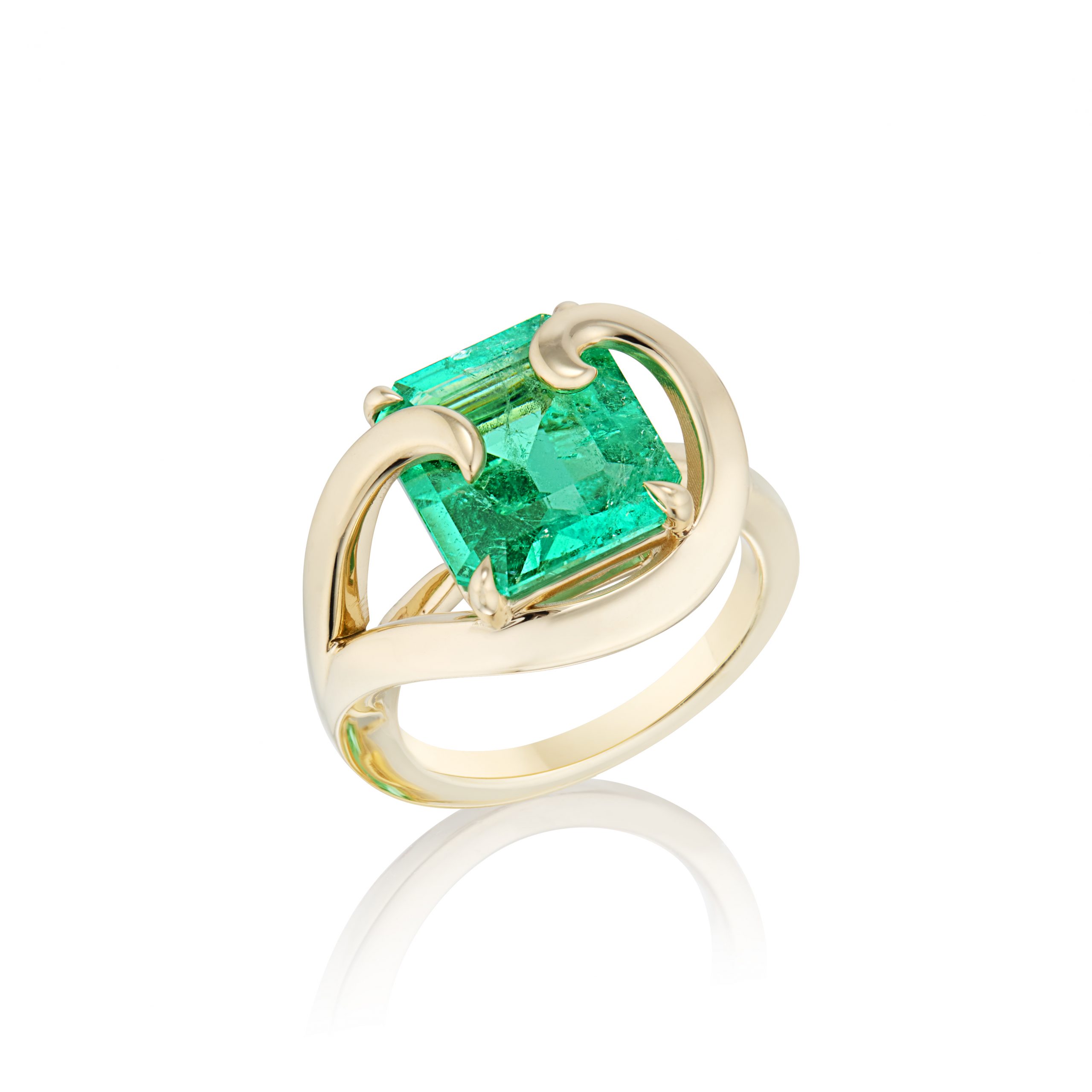
My Muzo Emerald Embrace ring holds a special place in my heart. It is crafted in 18K yellow gold around a beautiful Muzo emerald, and it was my first coloured-gemstone piece. That project challenged me and taught me something essential about my voice as a designer. I prefer to design from the stone outward. I let the gem lead, then build a form that protects it, frames it and lets the light do its work.
The ring’s language comes from the ocean. I shaped the gold to suggest two waves meeting, with intentional negative space so the emerald feels suspended, like water catching light. The hue of the stone carries the story. A few weeks after I finished it, I wore the ring outside and a bee landed right on the emerald. It felt like nature nodding back at me, a quiet confirmation that the piece captured the feeling I hoped for. I am proud of the clarity and restraint in that design, and it continues to remind me to listen to the stone first and let the rest unfold.
Do you see yourself as keeping jewelry making traditions alive, reinventing them, or creating something entirely new?
I do all three. I learn the rules and respect the craft, from classic goldsmithing and metalsmithing to stone setting and finishing. I reinvent mechanisms for modern wear, and I chase new forms that feel like sculpture for the body. I love understanding why a bezel holds, how a hinge should move, and what a hand polish can do to a surface. That foundation lets me reinvent with intention. I build mechanisms for modern wear, explore multiple-wear options, and use CAD and 3D prototypes to pressure test scale, balance, and movement on the body. From there I give myself room to create what feels entirely new. My goal is to make pieces that feel unexpected and versatile while honoring the discipline behind them. A necklace that converts to a choker, an earring that stacks two ways, a ring that rotates to reveal a second look. The innovation is never a trick. It is there to serve comfort, longevity, and story. If I can carry forward the centuries of technique, evolve the mechanics for how we live now, and still surprise you with a silhouette you have not seen before, then I am doing my job.
What role does technology play in your design process (e.g., CAD, 3D printing, digital sketching)?
Technology is a core part of how I think, build, and communicate. I always start with hand sketches to catch the first spark, then I move into CAD to refine proportion, mechanics, and how the piece will actually move on the body. My work often includes hinges, clasps, and multiple wear options, so CAD and 3D modeling let me test the engineering before I ever touch gold.
From there I create digital renderings to pressure test light, scale, and stone placement. Most clients do not visualize well from a flat drawing, so renders and short turntable videos help them see the piece in real space. I also print resin models so clients can hold the design, try it on, and feel weight and balance at scale. That tactile moment is powerful. It builds trust and surfaces feedback early, which saves time and protects the final materials.
I rely on tech for quality control and storytelling too. I keep a digital archive of iterations, measurements, and stone specs so every decision is documented. When needed, I use quick AR previews or simple hand videos overlaid with measurements to show fit on a finger, ear, or neck. Technology does not replace craft in my studio. It gives me clarity, helps me prove the mechanism, and lets my clients experience the design before the first cast is poured.
What values are reflected in your work (responsible sourcing, sustainability, other etc.), and how do you integrate those values into your collections?
I design with responsible sourcing, education, and longevity at the core. As a gemologist, integrity and traceability guide every decision, from meeting suppliers in person to sourcing stones directly from partners who share my values. I travel to source regions to see the supply chain with my own eyes, including Botswana and South Africa for diamonds, and India for manufacturing, with time in Mumbai and Jaipur. I work only with reputable suppliers who prioritize sustainability and fair practices. I also educate clients on materials and care, and I build versatile pieces with multiple wear options so they stay in rotation for years.
I also champion upcycling. A lot of my work involves restyling heirlooms into new, wearable art that clients cherish. We melt and reuse gold, reset stones, and preserve meaningful details so the history stays alive in a fresh form. It is a small but real way I contribute to a circular ecosystem, reduce waste, and design with intention.
Many younger jewelers emphasize storytelling. What story do you share with your jewelry?
My story is about movement, place, and becoming. Jewelry started as my refuge and a way to express what I could not always say out loud. As I stepped fully into being a designer, I made a promise to create pieces that help the wearer feel seen and powerful. I pull from New York , my Caribbean roots, and the places I have studied craft around the world, then translate that into clean structure, organic curves, and mechanisms that move with the body. Each piece is a small archive of where I have been and what I value, but it is also a spark for the person who wears it. I want my work to encourage someone to walk into a room and feel like themselves turned up, to “shine so bright the sun feels like the shade.”
How do your personal identity and background influence your work?
My identity is the foundation of my work. My Jamaican heritage and growing up in New York shaped me, and I see the world as an artist first. I translate what I love about nature, travel, fashion, and everyday design into metal and stone. I pull the grit and rhythm of the city into clean structure, and I bring the warmth and storytelling of my Caribbean heritage into curves, texture, and light. I want a piece to speak before I do. That idea clicked the first time I wore one of my own designs and strangers kept stopping me to ask about it. The jewelry introduced me before I said a word.
That is the energy I build into everything I make. The pieces are statements, sometimes bold and sometimes quiet, but always intentional. I want the wearer to feel seen, powerful, and grounded, with a small archive of my world and theirs living in the design.
What innovative approaches are you using to reach today’s consumer?
I meet clients where they are. Short-form video of process, virtual try-ons, micro content that teaches gem basics, and pop-ups that feel like studio visits. The power of social media can’t be understated. I create videos to provide consumers with a peek into my process and the inspiration of my travels on my designs through posts related to what inspired a particular piece.
How do you see the role of jewelry evolving for your generation, adornment, investment, self-expression, or all of the above? Any major shifts?
It is all of the above, and the center of gravity is shifting toward personal narrative with lasting value. Clients want pieces that mark milestones, feel like them, and hold up over time. They are taking their time, asking where materials come from, and choosing designs that do more than one thing. I see more people investing in gold and fine stones with the mindset that beauty and value can live together. Upcycling is part of that shift. We are melting and resetting heirlooms to create something new that still carries history. My job is to translate their story into a piece that can be worn often, layered easily, and appreciated as an asset they can cherish and, if needed, pass on.
Do you collaborate with other designers, artists, or industries to expand your creative practice?
I collaborate with photographers, stylists, and sometimes other designers. Cross-disciplinary projects push form and function in the best way.
What role does AI play in your business (if any)?
AI is my quiet studio assistant. I use it for mood boards, quick research, first-draft writing. It also transcribes virtual and in-person client meetings, then turns the notes into clear checklists, timelines, and design briefs, which helps me capture every detail and question. I lean on it to explore palettes, materials, and mechanisms, to draft captions and proposals, and to organize follow-ups so projects stay on track. It does not replace my hand or eye. It clears the noise so I can focus on design, clients, and craft. It speeds admin and frees me to focus on design and clients.
What advice would you give to other young jewelers just starting out?
Start small and start now. Your voice is the asset. Do not talk yourself out of the work because the market feels crowded. Your background, heritage, and eye are not replicable. Learn the bench basics so you understand what is possible, know your numbers so you can price for sustainability, and document everything so you can learn from each project. Share your process so the right clients can find you. Ask for feedback, find mentors, and build with peers who will trade knowledge and hold you accountable.
If you could redefine or change one thing about the jewelry industry, what would it be?
I believe the future is all about pathways. When we create clear entry points for young talent, the whole industry gets stronger. That looks like school-to-studio programs, paid apprenticeships, supplier relationships that welcome small orders, and real exposure to the full journey from sketch to CAD to the bench. Through the Future Jewelers Academy, which I co-founded and lead, we are doing exactly that with high school programs at Brooklyn STEAM Center in the Brooklyn Navy Yard and at Baldwin High School. Students get hands-on training, mentorship, and a direct line to careers. As more Gen Z voices come in through these pathways, we will see fresher ideas, smarter use of technology, and deeper accountability in sourcing and craft. Opening doors is how we grow design excellence, build community, and keep this beautiful art form thriving for generations.
Malyia McNaughton’s advice for emerging designers is clear: “Start small and start now. Your voice is your asset. Learn the bench basics, know your numbers, document your process and find mentors who will trade knowledge with you. The right people will find you when you show up consistently and with purpose.” Through Made by Malyia, Ms McNaughton continues to redefine what modern fine jewellery looks like: intelligent, intentional, and deeply human. Follow her on Instagram @madebymalyia